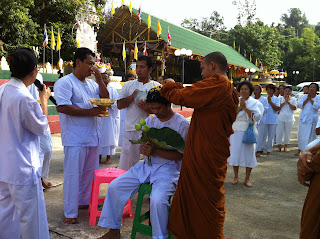
A lot of people love to talk about compassion and peace regarding home, foreign and domestic affairs. But did not have the compassion and peace in mind, then how will the true compassion and peace be formed?

所有的人,都爱说的范围是:国内,国外与家庭的慈悲与和平。但是反过来内心却没有慈悲与和平的想法,那么,真正的慈悲与和平怎样能形成的呢?

About me

My photo
Singapore
"All that we are is the result of what we have thought." The Buddha. "..Religion without Science is Blind, Science without religion is crippled." Albert Einstein 1879-1955
Showing posts with label Thai Buddhism. Show all posts

Saturday, 9 March 2013

My Amulet Collection - Phra Chinnaraj Tha Ruea Pim Yai


Phra Chinnaraj Tha Ruea Pim Yai
Wat Phra Baromathat
Archan Chum
Wat Mahathat, B.E 2497, Nakhon Si Thammarat


Thursday, 7 February 2013

Upagupta

Upagupta, the disciple of Buddha, lay sleep in
the dust by the city wall of Mathura.
Lamps were all out, doors were all shut, and
stars were all hidden by the murky sky of August.
Whose feet were those tinkling with anklets,
touching his breast of a sudden?
He woke up startled, and a light from a woman's
lamp fell on his forgiving eyes.
It was dancing girl, starred with jewels,
Wearing a pale blue mantle, drunk with the wine
of her youth.
She lowered her lamp and saw young face
austerely beautiful.
"Forgive me, young ascetic," said the woman,
"Graciously come to my house. The dusty earth
is not fit bed for you."
The young ascetic answered, "Woman,
go on your way;
When the time is ripe I will come to you."
Suddenly the black night showed its teeth
in a flash of lightening.
The storm growled from the corner of the sky, and
The woman trembled in fear of some unknown danger.

* * * **
A year has not yet passed.
It was evening of a day in April,
in spring season.
The branches of the way side trees were full of blossom.
Gay notes of a flute came floating in the
warm spring air from a far.
The citizens had gone to the woods for the
festival of flowers.
From the mid sky gazed the full moon on the
shadows of the silent town.
The young ascetic was walking along the lonely street,
While overhead the love-sick koels uttered from the
mango branches their sleepless plaint.
Upagupta passed through the city gates, and
stood at the base of the rampart.
Was that a woman lying at his feet in the
shadow of the mango grove?
Stuck with black prestilence, her body
spotted with sores of small-pox,
She had been hurriedly removed from the town
To avoid her poisonous contagion.
The ascetic sat by her side, took her head
on his knees,
And moistened her lips with water, and
smeared her body with sandal balm.
"Who are you, merciful one?" asked the woman.
"The time, at last, has come to visit you, and
I am here," replied the young ascetic.
 
 
Poem by Rabindranath Tagore

* Upagupta is also known as Moggaliputta Tissa or Upakut. I personally love this poem very much. This story touches my heart and I like to share with all of you the wisdom, compassion and the philosophy of Buddhism in this story.

Gassho,
Namu Myo Ho Renge Kyo,
Chikai


Sunday, 3 February 2013

My amulet collection - Phra Upakut

 
FRONT

 
BACK

Phra Upakut Thawee Sap
  Kruba Duang Dee
Wat Tha Jampee, Chiang Mai, BE 2553


Friday, 18 January 2013

The general basic functions of different kind of buddhist amulets (不同佛牌的基本功能)

General Buddha Image(佛祖像)

 
Protection , Health and Well Being
保平安,健康
 
Phra Somdej (祟笛佛)

 
 Protection, Career Luck, Offical Career Luck
保平安,助官运,事业
 
Phra Sothorn (所通佛)

 
 Protection, Health and Well Being
保平安,健康
 
Phra Nang Paya (古佛南帕亚)

 
  Protection, Everything smooth/success
保平安,事事顺利
 
Jade Buddha (玉佛)

 
 Protection, Career Luck, Offical Career Luck, Power
保平安,健康,助官运,事业,权力

Phra Chinnarat (火龙佛/成功佛/完美佛)


Protection, Authority
保平安, 权威

Phra Kring (药师佛)


Protection , Health/Well Being, Boost Wealth
保平安,健康, 助财运

Phra Nak Prok (七龙佛)


Protection, Ward off  Evil, Aviod Danger, Avoid Villain/Backstabing
保平安,避邪,挡险,避小人

Jatukam (泽渡康)


Help in Career, Wealth, Change of Luck
有助于事业,财运及转运

Phra Pidta (必达佛)


Ward off Evil, Block Disaster, Avoid Villain/Backstabing, Protection
避邪,挡灾,避小人,保平安


There are many stories about people wearing "powerful amulet" and able to escaped serious accident or able to overcome great problems or become very rich and successful. But one must understand that wearing an/many amulets is/are only a temperory solution. No one can escape the cause and effect of your own Karma. It will just delay/defer or if you are lucky, cushion the full force of your Karma. Amulet is just an enhancement to our life.When we wear the amulet, we are actually borrow the power/positive energy from Buddhas/Boddhisattvas/Arhants/Devas and Luang Por/Kruba/Archan to protect us and to help us. That is why we need to wear the amulets all the time for the amulets to work, to protect and to help us. But they can't cleanse our Karma away not even the Buddhas can do it. That is why Buddha always encourage us to practise the Dharma/Chanting and doing good deeds, and thru Dharma/Chanting, we will be able to cleanse ourselve from our own negative Karma created in the past and present. By practising correctly according to the teaching of the Buddha, not only we are also slowly creating positive energy to shield us, protecting deities of the Dharma will also protect us.
 
Namu Myo Hon Renge Kyo
Chikai
 

Tuesday, 15 January 2013

My amulet collection - LP Pinak Star Amulet

 
FRONT

 
SIDE

 
BACK
 
This is a very old batch handmade STAR amulet is made by LP Pinak (LP Phina or LP Pina or LP Pinut) of Wat Sanamlao

Tuesday, 8 January 2013

My amulet collection - LP Pinak Eye Amulet


Front 


Back

This is a very old batch handmade EYE amulet is made by LP Pinak (LP Phina or LP Pina or LP Pinut) of Wat Sanamlao.

Wednesday, 19 September 2012

出家

什么是出家?
 
我曾经遇到一位高人。我跟他说我要出家。那位高人问我,什么是出家?我听了后,愣了一下之后,我说:“出家不是离开家里,到寺庙里当和尚。”
 
那高人笑了笑后,就说:“ 剃度和披上加沙只不过是形式及外表上的出家而不是真正的出家。” “ 真正的出家是心里能脱离三界。”
 
“ 那三界是那三界呢?” 我问。
 
那高人说:“三界是色界,无色界和欲界。”
 
听了后,我想了想,这世上有多少人能做的到呢?相信没有几个人能做得到啊!


南无妙法莲华经
智海


Friday, 14 September 2012

My amulet collection - Small size Green Naga Eye


My amulet collection - Palad Hua Cha Mod Wat Sanamlao


This is a handmade old batch Palad Hua Cha Mod is made by LP Pinak (LP Phina or LP Pina or LP Pinut) of Wat Sanamlao.

Wednesday, 4 April 2012

What is Vesak Day?

Vesākha (Pali; Sanskrit: Vaiśākha, Devanagari: वैशाख) or Vesak is a holiday observed traditionally by Buddhists in Bangladesh, India, Nepal, Sri Lanka, and the South East Asian countries of Singapore, Vietnam, Thailand, Cambodia, Laos, Malaysia, Burma, and Indonesia. Sometimes informally called "Buddha's Birthday", it actually encompasses the birth, enlightenment (nirvāna), and passing away (Parinirvāna) of Gautama Buddha.

The exact date of Vesākha varies according to the various lunar calendars used in different traditions. In Theravada countries following the Buddhist calendar, it falls on a full moon Uposatha day, typically in the 5th or 6th lunar month. Vesākha Day in China is on the eighth of the fourth month in the Chinese lunar calendar. The date varies from year to year in the Western Gregorian calendar, but usually falls in April or May. In leap years Vesākha is celebrated in June.

The name of the observance is derived from the Pali term vesākha or Sanskrit vaiśākha, which is the name of the lunar month falling on April to May. In Mahayana Buddhist traditions, the holiday is known by its Sanskrit name and derived variants of it. Local renditions of the name varies by country, including:

  • Bangladesh: Bud-dho Purnyima (বুদ্ধ পূর্ণিমা) or Bud-dho Joyonti (বুদ্ধ জয়ন্তী)
  • Cambodia: Vesak Bochea
  • Chinese-speaking areas: Fó Dàn (佛誕) or Fāt Dàahn
  • Nepal: Buddha Purnima (बुद्ध पुर्णिमा) or Buddha Jayanti (बुद्ध जयंती)
  • Indonesia: Waisak
  • Japan: Hanamatsuri (花祭)
  • Korea: Seokka Tanshin-il (석가 탄신일, 釋迦誕身日)
  • Laos: Vixakha Bouxa
  • Malaysia: Hari Wesak
  • Myanmar (Burma): Kason Full Moon Day (ကဆုန်လပြည့်ဗုဒ္ဓနေ့)
  • Sri Lanka: Wesak (වෙසක්)
  • Thailand: Wisakha Bucha or Visakah Puja (วิสาขบูชา)
  • Tibet: Saga Dawa (*ས་ག་ཟླ་བ། )
  • Vietnam: Phật Đản

The decision to agree to celebrate the Vesākha as the Buddha’s birthday was formalized at the first Conference of the World Fellowship of Buddhists held in Sri Lanka in 1950, although festivals at this time in the Buddhist world are a centuries-old tradition. The Resolution that was adopted at the World Conference reads as follows:

" That this Conference of the World Fellowship of Buddhists, while recording its appreciation of the gracious act of His Majesty, the Maharaja of Nepal in making the full-moon day of Vesak a Public Holiday in Nepal, earnestly requests the Heads of Governments of all countries in which large or small number of Buddhists are to be found, to take steps to make the full-moon day in the month of May a Public Holiday in honour of the Buddha, who is universally acclaimed as one of the greatest benefactors of Humanity. "


On Vesākha Day, Buddhists all over the world commemorate events of significance to Buddhists of all traditions: The birth, enlightenment and the passing away of Gautama Buddha. As Buddhism spread from India it was assimilated into many foreign cultures, and consequently Vesākha is celebrated in many different ways all over the world.

In 1999, the United Nations resolved to internationally observe the day of Vesak at its headquarters and offices.

On Vesākha day, devout Buddhists and followers alike are expected and requested to assemble in their various temples before dawn for the ceremonial, and honorable, hoisting of the Buddhist flag and the singing of hymns in praise of the holy triple gem: The Buddha, The Dharma (his teachings), and The Sangha (his disciples). Devotees may bring simple offerings of flowers, candles and joss-sticks to lay at the feet of their teacher. These symbolic offerings are to remind followers that just as the beautiful flowers would wither away after a short while and the candles and joss-sticks would soon burn out, so too is life subject to decay and destruction. Devotees are enjoined to make a special effort to refrain from killing of any kind. They are encouraged to partake of vegetarian food for the day. In some countries, notably Sri Lanka, two days are set aside for the celebration of Vesākha and all liquor shops and slaughter houses are closed by government decree during the two days. Also birds, insects and animals are released by the thousands in what is known as a 'symbolic act to liberation'; of giving freedom to those who are in captivity, imprisoned, or tortured against their will. Some devout Buddhists will wear a simple white dress and spend the whole day in temples with renewed determination to observe the eight Precepts.

Devout Buddhists undertake to lead a noble life according to the teaching by making daily affirmations to observe the Five Precepts. However, on special days, notably new moon and full moon days, they observe the eight Precepts to train themselves to practice morality, simplicity and humility.

Some temples also display a small image of the baby Buddha in front of the altar in a small basin filled with water and decorated with flowers, allowing devotees to pour water over the statue; it is symbolic of the cleansing of a practitioners bad karma, and to reenact the events following the Buddha's birth, when devas and spirits made heavenly offerings to him.

Devotees are expected to listen to talks given by monks. On this day monks will recite verses uttered by the Buddha twenty-five centuries ago, to invoke peace and happiness for the Government and the people. Buddhists are reminded to live in harmony with people of other faiths and to respect the beliefs of other people as the Buddha had taught.

Celebrating Vesākha also means making special efforts to bring happiness to the unfortunate like the aged, the handicapped and the sick. To this day, Buddhists will distribute gifts in cash and kind to various charitable homes throughout the country. Vesākha is also a time for great joy and happiness, expressed not by pandering to one’s appetites but by concentrating on useful activities such as decorating and illuminating temples, painting and creating exquisite scenes from the life of the Buddha for public dissemination. Devout Buddhists also vie with one another to provide refreshments and vegetarian food to followers who visit the temple to pay homage to the Enlightened One.

Tradition ascribes to the Buddha himself instruction on how to pay him homage. Just before he died, he saw his faithful attendant Ananda, weeping. The Buddha advised him not to weep, but to understand the universal law that all compounded things (including even his own body) must disintegrate. He advised everyone not to cry over the disintegration of the physical body but to regard his teachings (The Dhamma) as their teacher from then on, because only the Dhamma truth is eternal and not subject to the law of change. He also stressed that the way to pay homage to him was not merely by offering flowers, incense, and lights, but by truly and sincerely striving to follow his teachings. This is how buddhists are expected to celebrate Vesak: to use the opportunity to reiterate their determination to lead noble lives, to develop their minds, to practise loving-kindness and to bring peace and harmony to humanity.

* Reference to Wikipeida

Wednesday, 19 October 2011

Is Buddhism scientific?

Before we answer that question it would be best to define the word 'science'. Science is, according to the dictionary, 'knowledge which can be made into a system, which depends upon seeing and testing facts and stating general natural laws, a branch of such knowledge, anything that can be studied exactly'. There are aspects of Buddhism that would not fit into this definition but the central teaching of Buddhism, the Four Noble Truths, most certainly would. Suffering, the First Noble Truth, is an experience that can be defined, experienced and measured. The Second Noble Truth states that suffering has a natural cause, craving, which likewise can be defined, experience and measured. No attempts is made to explain suffering in terms of a metaphysical concept or myths. According to the Third Noble Truth, suffering is ended, not by relying upon a supreme being, by faith or by prayer but simply by removing its cause. This is axiomatic. The Fourth Noble truth, the way to end suffering, once again, has nothing to do with metaphysics but depends on behaving in specific ways. And once again behavior is open to testing. Buddhism dispense with the concept of a supreme being, as does science, and explains the origins and workings of the universe in terms of natural laws. All of this certainly exhibits a scientific spirit. Once again, the Buddha's constant advise that we should not blindly believe but rather question, examine, inquire and rely on our own experience, has a definite scientific ring to it. In his famous Kalama Sutta the Buddha says;

'Do not go by revelation or tradition, do not go by rumor or the sacred scriptures, do not go by hearsay or mere logic, do not go by bias towards a notion or by another person's seeming ability and do not go by the idea "He is our teacher". But when yourself know that a thing is good, that it is laudable, that it is praised by the wise and when practiced and observed that it leads to happiness, then follow that thing'. A.I,188

So we could say that although Buddhism is not entirely scientific, it certainly has a strong scientific overtone and is certainly more scientific than any other religion. It is significant that Albert Einstein, the greatest scientist of the 20th century said of Buddhism:

'The religion of the future will be a cosmic religion. It should transcend a personal God and avoid dogmas and theology. Covering both natural and the spiritual, it should be based on a religion sense arising from experience of all things, natural and spiritual and a meaningful unity. Buddhism answers this description. If there is any religion that would cope with modern scientific needs, it would be Buddhism'.


by S. Dhammika

Tuesday, 11 October 2011

Words of Wisdom 19


All that we are is the result of what we have thought;
is is founded on our thoughts.

If a man speaks or acts with pure thought,
joy will follow him,
like a shadow tat never leaves him.

Friday, 7 October 2011

Short Katha for Phra Somdej Archan Toh


Namo Tassa Bhagavato Arahato
Samma Sam Bud Tassa x 3

Metta Khunang Arahang Metta x 9

Katha for Tok Raja Phra Pidta


Namo Tassa Bhavato Arahato 
Samma Sam Bud Tassa  x 3

Namo Bodhi Sato 
Punnak Suwanno Pasittimay  x 3

E Rak Ja Kha
Tha Rak Sa
Ti Hang Jak
Tho Ro Ti Nang
Pi Sam Ra Ro
Bu Sa Bu
( You can repeat 3, 9 or as many time as you like)


Words of Wisdom 18


Hatred never cease by hatred,

But by love.


Tuesday, 4 October 2011

My amulet collection - Phra Pidta Phakawan Wat Bangsek B.E.2480


督拉惹 (Tok Raja/LP Khron)


在馬來亞佛教界裏,曾被泰國覲選一百零八位頂尖兒高僧裡,唯一不屬於泰國境內的高僧,就是信徒尊稱為“督拉惹”的高僧,也是唯一被回教蘇丹王室御封為“督拉惹”的高僧。

督拉惹” Tok Raja,意譯為督,馬來語是公公、法師、村長及長輩等的意思。拉惹” 意譯為蘇丹王室,結合起來督拉惹應該是,王室僧簡稱為僧王更有人稱鑾波為馬來亞必打王ปิดตาPitta),可想而知,他所鑄造的必打是多麼出名的。但簡稱鑾波為阿祖阿公,較為有親切感。泰族人稱鑾波為鑾波昆榜錫หลวงพ่อครน บางแซะ Luangpo Kron Bangsek)。

鑾波昆出生於1876年(佛曆2419112日,星期四屬鼠年,當時還是暹羅管轄時代的吉蘭丹,父親名叫乃村,母親叫喃喬,姓氏為叻乍倫(Rajcharuen)。

鑾波昆十二歲時,父親才帶他去越烏塔瑪喃 วัดอุตตมารามWat Uttamaram),也稱越榜錫วัดบางแซะ(Wat Bangsek),隨寺院主持學習泰文,過後又學會了巴利文,而能朗誦經文。鑾波自從進入寺院,學習語文後,就非常喜愛研讀經書,甚少遊樂,與其他孩童性格絕然不同。住持在觀察下,就覺得此孩童,似乎前世曾修過梵行,看他的一舉一動皆有僧侶的風範,他日必為僧中之尊呀!

鑾波讀完寺院裏的經書後,他也不願回家,繼續留在那裡,幫忙做個方面之事,同時也教村中的小孩們學習泰語。到年齡二十一歲時,鑾波要求父母給他籌備出家之事,父母也和親友們為他剃度受戒為僧人。於1895年(佛2438615日,為受戒的是柏巴叻差法師,鑾波的法名柏昆普納蘇瓦若 (Phra Kron Punnasuwanno)起先鑾波昆用兩年的時間深入的研習大藏經,過後他覺得自己應該出外走走,尋求更高一層的佛學知識。就毅然此外了住持,步行出發去修苦行戒律。但是當時沒有良好的道路,只好翻山越嶺,當然得徒步行走。整個月後來到了一個村莊,有間寺院越蓮乍(Wat Leamchak),得知有位法力高強的高僧,叫做鑾波瑪哈蕾(Luang Phor  Mahaloi)。起初鑾波瑪哈蕾將一本法術秘笈交與督拉惹,他得花上兩年時間方能背誦通笈交裏的經文,接着更深的修禪定法門。其後他也各地去尋訪名師讚研各門法術,而且還在泰南各府,當了多間佛寺的主持。督拉惹多住在宋卡府和高頭廊府一帶,也曾在越考烏(Wat Khao-Or)修習多種信物的獨特法門。 1925年(佛曆2468)督拉惹辭去越邁考嶺的主持職位,決定回到家鄉,接任越烏塔瑪喃的住持方丈。 


他準備大肆修葺寺院。當時周圍都被膠園團團圍住,寺院的地大約二十多英畝。居民多是以割膠為生,過的生活的相當辛苦,不過每逢節日卻都非常誠心的前來獻僧供佛,有者今天看他們歡天喜地的來獻僧,明天卻穿來他的惡訊,說是被蛇咬死了!因為樹膠園裏毒蛇叢生,尤其是眼鏡蛇,在攻擊人的時候,豎起起來像人一般高。 

鑾波看到這種情景,非常難過,就將以前修苦行戒時所收集的聖土,用來製造避險的信物,這就是初期鑾波製造掩面佛的心意,製成後派發給信徒,信徒佩帶後果真一路平安無事,更奇怪的是毒蛇遇上有佩帶必打佛牌的村民,都會掉頭而逃,不敢接近,甚至碰上老虎、熊也會出現相同的情況,信徒們一傳十,十傳百,鑾波的必打佛像就慢慢的火紅起來。

從前要去寺院很艱難,因為交通很不方便,只有從水路和火車才能達到寺院,有些信徒甚至跟隨火車鐵軌走了十多哩才到達寺院,因為哥打峇魯到蘭斗班讓間是沒有火車站的,有些信徒都是去到蘭斗班讓在走回頭,但路程也要數哩之遙。 
曾經有比較熟的信徒,要到鑾波昆寺院之前,就會先買了煙。然後才上火車;在火車上,就會走到車頭,找駕駛員打交道,順便送上煙給他,要求火車經過寺院時,儘量放慢車速,好讓他們有機會從火車上跳下去,如此一來就節省了很多時間和精力。 信徒一到寺院,一般先回和鑾波閒談,鑾波是一位很健談的僧人,不會難以相處,而當信徒要求必打佛時,鑾波就會記錄下他個人的行業和需要,如果是做生意者,鑾波就會多下人緣咒。然後才然後再擇日鋳造制模,集會聖土、經水和石灰等,放進模型裏印出了一枚必打佛牌。 鑾波才利用小刀片,慢慢的雕出完美的曲線,然後以畫圖的鐵筆,一邊唸經,一邊將符咒寫在必打的身上,再放入法壇上,日夜誦經,直至兩三個月後,信徒才可以奉請佩戴。所以每一枚必打佛牌,都是鑾波要每枚佛牌都呈現最完美的形象,讓人看上去,就非常渴望將之擁有。這就是督拉惹必打佛牌最獨特之處。


關於督拉惹的必打佛牌威力,是不可置疑的,而且為信徒們所公認的,就連暹羅的佛牌收藏家們都會來尋找這塊寶物,現在此必打佛牌,在市場價值大約處於五十萬株左右。即使鑾波昆生前鋳造的銅佛牌市價都值越十萬銖左右呢!

鑾波昆所住的吉蘭丹州,鑾波在這裡卻沒有受到回教徒的排擠,鑾波有高深的法力,時常幫忙這些馬來同胞解決一些玄難雜症,如中邪、中降、小孩子哭個不停等的問題。鑾波昆也常常唸一些經水讓他們帶回去飲用或洗澡,一般可以解決一些玄妙的問題。甚至連吉蘭丹蘇丹也親自覲見鑾波,並向鑾波談起說:他每次去舉行王室儀式時,都會感到頭頂有撕裂頭痛的感覺,因為其中有一點血統奧妙的差距。鑾波就說沒有問題,走入佛舍裏,拿出長約一尺多的手杖。 
 
此手杖泰語成為“邁古魯”ไม้คูรู(Mai Kru),意譯是師父杖或權杖。此杖的功能是增加權威,避一切的邪惡。鑾波昆就把它交給吉蘭丹蘇丹王。而蘇丹王從此每次開王室大會時,再也不會發生頭痛的問題。而蘇丹永遠手不離此權杖,時常緊隨於身。蘇丹為了感謝鑾波昆的恩典,就第一次封泰族高僧為僧王,馬來語就是督拉惹Tok Raya)。 


說鑾波昆在修苦行戒律時,去到一座山洞,見到一位修行老僧在裡頭居住,鑾波就朝拜此老僧,並向他學習禪定法門。 過了三個月的守夏節。有一天老僧叫鑾波昆來到床前,這時候老僧已病倒再創了,老僧將一支拐杖狀的木棍交給鑾波,說是當年他年輕時候有位高僧交給他的,並吩咐他說他日得遇見有慧根者才傳交於他,並傳授口訣以及製造邁古魯的秘訣,鑾波昆就是從此處學來的。 鑾波得到邁古魯後,就日夜擁帶在身旁,連睡覺也相隨,覺得得到邁古魯後,自己的法力也隋着增長。不久之後傳邁古魯於他的老僧也圓寂了。

後來鑾波昆製造了數支邁古魯給有需要的人士,吉蘭丹蘇丹的就是其中一支。這隻邁古魯現在還供奉在蘇丹宮裏哪!

自從鑾波昆回到家鄉主持寺院,首先就是着手發展教育、建設校舍,並由柏嗎哈曾當老師。接着還籌建了一間全馬甚至暹羅所無悟的,與眾不同的是和大雄寶殿。四方有門進出,前門的十二支大柱子有祥龍盤捲的雕刻,更有許多奇珍異獸的雕像團團圍繞,計有龍、象、獅、虎、鹿、鷹及牛等等。進口處兩旁築了兩座神龕,分別供奉大伯公與觀音大士的聖像,蔚為奇觀。 從此這裡就變成好像少林寺一樣,有許多僧侶和法師紛紛前來拜在鑾波昆的門下,不是學武術,而是學法術。學成之後可以籍着法術救人於苦難中,這也是鑾波教授法術的宗旨。
1962年(佛曆2505年),鑾波昆剛由新加坡回來之後,就不舒服臥病在床,吉蘭丹蘇丹也親自前來探病。鑾波年事已高,終於在1119日圓寂,享年88歲,入戒68年,一代聖僧從此沉寂了 ......


Monday, 3 October 2011

Why are there so many different types of Buddhism?

There are many different types of sugar - brown sugar, white sugar, rock sugar, syrup and icing sugar - but it is all sugar and it all tastes sweet. It is produced in different forms so that it can be used in different ways. Buddhism is the same: there is Theravada Buddhism, Zen Buddhism, Pure Land Buddhism, Yogacara Buddhism, Vajrayana Buddhism and Nichiren Buddhism but it is all the teaching of the Buddha and it all has the same taste - taste of freedom. Buddhism has evolved into different forms so that it can be relevent to different cultures in which it exists. It has been reinterpreted over the centuries so that it can remain relevant to each new generation. Outwardly, the types of Buddhism may seem very different but at the center of all of them are the Four Noble Truths and the Eightfold path. All major religions, Buddhism included, have split into schools and sects. Perhaps the difference between Buddhism and some other religions is that the various school have generally been very tolerant and friendly towards each other.


* Reference to S.Dhammika

Dedication


Due to this merits,
May I soon,
Attain the enlightened state of Guru Buddha,
That I may be able to librate all sentient beings from their suffering.

May the precious bodhi mind, Not yet been born in me, will arise and grow.
May the birth have no decline, and will increase forever more.

Namu Myo Ho Renge Kyo
Namo Buddhaya
Namo Dharmaya
Namo Sanghaya