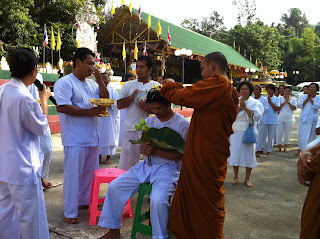
A lot of people love to talk about compassion and peace regarding home, foreign and domestic affairs. But did not have the compassion and peace in mind, then how will the true compassion and peace be formed?

所有的人,都爱说的范围是:国内,国外与家庭的慈悲与和平。但是反过来内心却没有慈悲与和平的想法,那么,真正的慈悲与和平怎样能形成的呢?

About me

My photo
Singapore
"All that we are is the result of what we have thought." The Buddha. "..Religion without Science is Blind, Science without religion is crippled." Albert Einstein 1879-1955
Showing posts with label Buddhism. Show all posts

Sunday, 18 January 2015

Law of the Twelve Causes


Law of the Twelve Causes, 
namely:
'Ignorance causes action; action causes consciousness; consciousness causes name and form; name and form cause the six entrances [or sense organs]; the six entrances cause contact; contact causes sensation; sensation causes desire [or love]; desire causes clinging; clinging causes existence; existence causes birth; birth causes old age and death, grief, lamentation, suffering, and distress.'

Ignorance annihilated, then action is annihilated; action annihilated, then consciousness is annihilated; consciousness annihilated, then name and form are annihilated; name and form annihilated, then the six entrances are annihilated; the six entrances annihilated, then contact is annihilated; contact annihilated, then sensation is annihilated; sensation annihilated, then desire is annihilated; desire annihilated, then clinging is annihilated; clinging annihilated, then existence is annihilated; existence annihilated, then birth is annihilated; birth being annihilated, then are annihilated old age and death, grief, lamentation, suffering, and distress.' 


Tathagata Universal Surpassing Wisdom
Lotus Sutra Chapter VII -The Parable of the Magic City


Sunday, 11 January 2015

Karma

What is Karma? Karma is the Sanskrit word for action. It is equivalent to Newton’s law of ‘every action must have a reaction’. When we think, speak or act we initiate a force that will react accordingly. This returning force maybe modified, changed or suspended, but most people will not be able eradicate it.
This law of cause and effect is not punishment, but is wholly for the sake of education or learning.
A person may not escape the consequences of his actions, but he will suffer only if he himself has made the conditions ripe for his suffering. Ignorance of the law is no excuse whether the laws are man-made or universal.
To stop being afraid and to start being empowered in the worlds of karma and reincarnation, here is what you need to know about karmic laws.

- “As you sow, so shall you reap”. This is also known as the “Law of Cause and Effect”.
- Whatever we put out in the Universe is what comes back to us.
- If what we want is Happiness, Peace, Love, Friendship… Then we should BE Happy, Peaceful, Loving and a True Friend.
2. THE LAW OF CREATION
- Life doesn’t just HAPPEN, it requires our participation.
- We are one with the Universe, both inside and out. – Whatever surrounds us gives us clues to our inner state.
- BE yourself, and surround yourself with what you want to have present in your Life.
3. THE LAW OF HUMILITY
- What you refuse to accept, will continue for you.
- If what we see is an enemy, or someone with a character trait that we find to be negative, then we ourselves are not focused on a higher level of existence.
4. THE LAW OF GROWTH
- “Wherever you go, there you are”.
- For us to GROW in Spirit, it is we who must change – and not the people, places or things around us.
- The only given we have in our lives is OURSELVES and that is the only factor we have control over.
- When we change who and what we are within our heart our life follows suit and changes too. THE
5. LAW OF RESPONSIBILITY
- Whenever there is something wrong in my life, there is something wrong in me.
- We mirror what surrounds us – and what surrounds us mirrors us; this is a Universal Truth.
- We must take responsibility what is in our life.
6. THE LAW OF CONNECTION
- Even if something we do seems inconsequential, it is very important that it gets done as everything in the Universe is connected.
- Each step leads to the next step, and so forth and so on.
- Someone must do the initial work to get a job done.
- Neither the first step nor the last are of greater significance,
- As they were both needed to accomplish the task.
- Past-Present-Future they are all connected…
7. THE LAW OF FOCUS
- You can not think of two things at the same time.
- When our focus is on Spiritual Values, it is impossible for us to have lower thoughts such as greed or anger.
8. THE LAW OF GIVING AND HOSPITALITY
- If you believe something to be true,then sometime in your life you will be called upon to demonstrate that particular truth.
- Here is where we put what we CLAIM that we have learned, into actual PRACTICE.
9. THE LAW OF HERE AND NOW
- Looking backward to examine what was, prevents us from being totally in the HERE AND NOW.
- Old thoughts, old patterns of behavior, old dreams…
- Prevent us from having new ones.
10. THE LAW OF CHANGE
- History repeats itself until we learn the lessons that we need to change our path.
11. THE LAW OF PATIENCE AND REWARD
- All Rewards require initial toil.
- Rewards of lasting value require patient and persistent toil.
- True joy follows doing what we’re suppose to be doing, and waiting for the reward to come in on its own time.
12. THE LAW OF SIGNIFICANCE AND INSPIRATION
- You get back from something whatever YOU have put into it.
- The true value of something is a direct result of the energy and intent that is put into it.
- Every personal contribution is also a contribution to the Whole.
- Lack luster contributions have no impact on the Whole, nor do they work to diminish it.
- Loving contributions bring life to, and inspire, the Whole.
Source:
BlissReturned , RavenEmrys, social-consciousness , 

Monday, 15 July 2013

The Odaimoku 御题目

  The form of worship instituted by Nichiren Daishonin is the repetitive recitation of the Scripture's Scared Title or the Odaimoku :"Namu Myoho Renge Kyo," that is the "Adoration to the Scripture of the Lotus of the Perfect Truth."

  His profound understanding of theology casused him to see the need for a simplified practice of affirming our affinity to Budhha and his true teachings. The answer he asserts is found uttering the Odaimoku. According to Nichiren Daishonin, the Odaimoku is not mere representation of Budhha's Truths. Rather it is the embodiment of the Buddha's Truths when the formula is uttered with a firm belief of the truths contained in the Lotus Sutra and full acceptance of Buddha as the Saviour.

  日莲大圣人创立的供佛形式是不断重复地唱诵 <妙法莲华经>。也称之为御题目 <南无妙法莲华经>,意思是"对 <法华经> 的经文根本真理的归依"。

  日莲大圣人对佛学的深奥理解使他意识到,通过一种表明我们信奉佛陀与其教义的简化修行方式的须要。他所主张的简化的修行方式就是反复唱诵御题目。根据日莲大圣人,御题目不仅是代表佛陀的真教义,而当人们心中坚信 <法华经> 所揭示的真理,并接受佛陀为救世主时,他们此时所唱诵的御题目"南无妙法莲华经"便成为佛陀真理的化身了。


Namu Myoho Renge Kyo
Namo Buddhaya
Namo Dharmaya
Namo Sanghaya


Reference Nichiren Shu 日莲宗

Tuesday, 9 July 2013

佛和心


心就是佛
佛就是心
心法也就是佛法
佛法也就是心法
当修成心法时
也就是悟道时


Special Thanks to Master Ma

Friday, 29 March 2013

Heart of Shurangama Mantra

 
Om
Anale Anale
Visada Visada
Bandha Bandha
Bandhani Bandhani
Vaira Vajrapani Phat
Hum
Bhrum Phat Svaha


Saturday, 9 March 2013

My Amulet Collection - Phra Chinnaraj Tha Ruea Pim Yai


Phra Chinnaraj Tha Ruea Pim Yai
Wat Phra Baromathat
Archan Chum
Wat Mahathat, B.E 2497, Nakhon Si Thammarat


Thursday, 7 February 2013

Upagupta

Upagupta, the disciple of Buddha, lay sleep in
the dust by the city wall of Mathura.
Lamps were all out, doors were all shut, and
stars were all hidden by the murky sky of August.
Whose feet were those tinkling with anklets,
touching his breast of a sudden?
He woke up startled, and a light from a woman's
lamp fell on his forgiving eyes.
It was dancing girl, starred with jewels,
Wearing a pale blue mantle, drunk with the wine
of her youth.
She lowered her lamp and saw young face
austerely beautiful.
"Forgive me, young ascetic," said the woman,
"Graciously come to my house. The dusty earth
is not fit bed for you."
The young ascetic answered, "Woman,
go on your way;
When the time is ripe I will come to you."
Suddenly the black night showed its teeth
in a flash of lightening.
The storm growled from the corner of the sky, and
The woman trembled in fear of some unknown danger.

* * * **
A year has not yet passed.
It was evening of a day in April,
in spring season.
The branches of the way side trees were full of blossom.
Gay notes of a flute came floating in the
warm spring air from a far.
The citizens had gone to the woods for the
festival of flowers.
From the mid sky gazed the full moon on the
shadows of the silent town.
The young ascetic was walking along the lonely street,
While overhead the love-sick koels uttered from the
mango branches their sleepless plaint.
Upagupta passed through the city gates, and
stood at the base of the rampart.
Was that a woman lying at his feet in the
shadow of the mango grove?
Stuck with black prestilence, her body
spotted with sores of small-pox,
She had been hurriedly removed from the town
To avoid her poisonous contagion.
The ascetic sat by her side, took her head
on his knees,
And moistened her lips with water, and
smeared her body with sandal balm.
"Who are you, merciful one?" asked the woman.
"The time, at last, has come to visit you, and
I am here," replied the young ascetic.
 
 
Poem by Rabindranath Tagore

* Upagupta is also known as Moggaliputta Tissa or Upakut. I personally love this poem very much. This story touches my heart and I like to share with all of you the wisdom, compassion and the philosophy of Buddhism in this story.

Gassho,
Namu Myo Ho Renge Kyo,
Chikai


Sunday, 3 February 2013

My amulet collection - Phra Upakut

 
FRONT

 
BACK

Phra Upakut Thawee Sap
  Kruba Duang Dee
Wat Tha Jampee, Chiang Mai, BE 2553


Friday, 18 January 2013

The general basic functions of different kind of buddhist amulets (不同佛牌的基本功能)

General Buddha Image(佛祖像)

 
Protection , Health and Well Being
保平安,健康
 
Phra Somdej (祟笛佛)

 
 Protection, Career Luck, Offical Career Luck
保平安,助官运,事业
 
Phra Sothorn (所通佛)

 
 Protection, Health and Well Being
保平安,健康
 
Phra Nang Paya (古佛南帕亚)

 
  Protection, Everything smooth/success
保平安,事事顺利
 
Jade Buddha (玉佛)

 
 Protection, Career Luck, Offical Career Luck, Power
保平安,健康,助官运,事业,权力

Phra Chinnarat (火龙佛/成功佛/完美佛)


Protection, Authority
保平安, 权威

Phra Kring (药师佛)


Protection , Health/Well Being, Boost Wealth
保平安,健康, 助财运

Phra Nak Prok (七龙佛)


Protection, Ward off  Evil, Aviod Danger, Avoid Villain/Backstabing
保平安,避邪,挡险,避小人

Jatukam (泽渡康)


Help in Career, Wealth, Change of Luck
有助于事业,财运及转运

Phra Pidta (必达佛)


Ward off Evil, Block Disaster, Avoid Villain/Backstabing, Protection
避邪,挡灾,避小人,保平安


There are many stories about people wearing "powerful amulet" and able to escaped serious accident or able to overcome great problems or become very rich and successful. But one must understand that wearing an/many amulets is/are only a temperory solution. No one can escape the cause and effect of your own Karma. It will just delay/defer or if you are lucky, cushion the full force of your Karma. Amulet is just an enhancement to our life.When we wear the amulet, we are actually borrow the power/positive energy from Buddhas/Boddhisattvas/Arhants/Devas and Luang Por/Kruba/Archan to protect us and to help us. That is why we need to wear the amulets all the time for the amulets to work, to protect and to help us. But they can't cleanse our Karma away not even the Buddhas can do it. That is why Buddha always encourage us to practise the Dharma/Chanting and doing good deeds, and thru Dharma/Chanting, we will be able to cleanse ourselve from our own negative Karma created in the past and present. By practising correctly according to the teaching of the Buddha, not only we are also slowly creating positive energy to shield us, protecting deities of the Dharma will also protect us.
 
Namu Myo Hon Renge Kyo
Chikai
 

Tuesday, 15 January 2013

My amulet collection - LP Pinak Star Amulet

 
FRONT

 
SIDE

 
BACK
 
This is a very old batch handmade STAR amulet is made by LP Pinak (LP Phina or LP Pina or LP Pinut) of Wat Sanamlao

Tuesday, 8 January 2013

My amulet collection - LP Pinak Eye Amulet


Front 


Back

This is a very old batch handmade EYE amulet is made by LP Pinak (LP Phina or LP Pina or LP Pinut) of Wat Sanamlao.

Wednesday, 19 September 2012

出家

什么是出家?
 
我曾经遇到一位高人。我跟他说我要出家。那位高人问我,什么是出家?我听了后,愣了一下之后,我说:“出家不是离开家里,到寺庙里当和尚。”
 
那高人笑了笑后,就说:“ 剃度和披上加沙只不过是形式及外表上的出家而不是真正的出家。” “ 真正的出家是心里能脱离三界。”
 
“ 那三界是那三界呢?” 我问。
 
那高人说:“三界是色界,无色界和欲界。”
 
听了后,我想了想,这世上有多少人能做的到呢?相信没有几个人能做得到啊!


南无妙法莲华经
智海


Friday, 14 September 2012

My amulet collection - Palad Hua Cha Mod Wat Sanamlao


This is a handmade old batch Palad Hua Cha Mod is made by LP Pinak (LP Phina or LP Pina or LP Pinut) of Wat Sanamlao.

Thursday, 21 June 2012

What is Gassho mean?

Gassho (Japanese pronunciation of the Chinese 合掌 he zhang ) is the translation of the Sanskrit "Anjali" . It is actually a mudra in Buddhism: The joining of the one's palms - held at the breast level - as a symbol of reverance, salutation or benedication. It is, for example, the traditional mudra across the Buddhist world when one formally takes refuge in the three treasures - the Buddha, the teachings (dharma) and the community (sangha).

In popular Japanese usage, gassho-suru means the joining of the palms - held at chest level - as a sign not really of thanks per se but veneration. When directed at a person it is a recognition - not of the personality - but of the "divinity" (the Buddha-nature) "within".

Gassho,
Namu Myo Ho Renge Kyo
Chikai

* Reference to Ryhorikawa

Wednesday, 4 April 2012

What is Vesak Day?

Vesākha (Pali; Sanskrit: Vaiśākha, Devanagari: वैशाख) or Vesak is a holiday observed traditionally by Buddhists in Bangladesh, India, Nepal, Sri Lanka, and the South East Asian countries of Singapore, Vietnam, Thailand, Cambodia, Laos, Malaysia, Burma, and Indonesia. Sometimes informally called "Buddha's Birthday", it actually encompasses the birth, enlightenment (nirvāna), and passing away (Parinirvāna) of Gautama Buddha.

The exact date of Vesākha varies according to the various lunar calendars used in different traditions. In Theravada countries following the Buddhist calendar, it falls on a full moon Uposatha day, typically in the 5th or 6th lunar month. Vesākha Day in China is on the eighth of the fourth month in the Chinese lunar calendar. The date varies from year to year in the Western Gregorian calendar, but usually falls in April or May. In leap years Vesākha is celebrated in June.

The name of the observance is derived from the Pali term vesākha or Sanskrit vaiśākha, which is the name of the lunar month falling on April to May. In Mahayana Buddhist traditions, the holiday is known by its Sanskrit name and derived variants of it. Local renditions of the name varies by country, including:

  • Bangladesh: Bud-dho Purnyima (বুদ্ধ পূর্ণিমা) or Bud-dho Joyonti (বুদ্ধ জয়ন্তী)
  • Cambodia: Vesak Bochea
  • Chinese-speaking areas: Fó Dàn (佛誕) or Fāt Dàahn
  • Nepal: Buddha Purnima (बुद्ध पुर्णिमा) or Buddha Jayanti (बुद्ध जयंती)
  • Indonesia: Waisak
  • Japan: Hanamatsuri (花祭)
  • Korea: Seokka Tanshin-il (석가 탄신일, 釋迦誕身日)
  • Laos: Vixakha Bouxa
  • Malaysia: Hari Wesak
  • Myanmar (Burma): Kason Full Moon Day (ကဆုန်လပြည့်ဗုဒ္ဓနေ့)
  • Sri Lanka: Wesak (වෙසක්)
  • Thailand: Wisakha Bucha or Visakah Puja (วิสาขบูชา)
  • Tibet: Saga Dawa (*ས་ག་ཟླ་བ། )
  • Vietnam: Phật Đản

The decision to agree to celebrate the Vesākha as the Buddha’s birthday was formalized at the first Conference of the World Fellowship of Buddhists held in Sri Lanka in 1950, although festivals at this time in the Buddhist world are a centuries-old tradition. The Resolution that was adopted at the World Conference reads as follows:

" That this Conference of the World Fellowship of Buddhists, while recording its appreciation of the gracious act of His Majesty, the Maharaja of Nepal in making the full-moon day of Vesak a Public Holiday in Nepal, earnestly requests the Heads of Governments of all countries in which large or small number of Buddhists are to be found, to take steps to make the full-moon day in the month of May a Public Holiday in honour of the Buddha, who is universally acclaimed as one of the greatest benefactors of Humanity. "


On Vesākha Day, Buddhists all over the world commemorate events of significance to Buddhists of all traditions: The birth, enlightenment and the passing away of Gautama Buddha. As Buddhism spread from India it was assimilated into many foreign cultures, and consequently Vesākha is celebrated in many different ways all over the world.

In 1999, the United Nations resolved to internationally observe the day of Vesak at its headquarters and offices.

On Vesākha day, devout Buddhists and followers alike are expected and requested to assemble in their various temples before dawn for the ceremonial, and honorable, hoisting of the Buddhist flag and the singing of hymns in praise of the holy triple gem: The Buddha, The Dharma (his teachings), and The Sangha (his disciples). Devotees may bring simple offerings of flowers, candles and joss-sticks to lay at the feet of their teacher. These symbolic offerings are to remind followers that just as the beautiful flowers would wither away after a short while and the candles and joss-sticks would soon burn out, so too is life subject to decay and destruction. Devotees are enjoined to make a special effort to refrain from killing of any kind. They are encouraged to partake of vegetarian food for the day. In some countries, notably Sri Lanka, two days are set aside for the celebration of Vesākha and all liquor shops and slaughter houses are closed by government decree during the two days. Also birds, insects and animals are released by the thousands in what is known as a 'symbolic act to liberation'; of giving freedom to those who are in captivity, imprisoned, or tortured against their will. Some devout Buddhists will wear a simple white dress and spend the whole day in temples with renewed determination to observe the eight Precepts.

Devout Buddhists undertake to lead a noble life according to the teaching by making daily affirmations to observe the Five Precepts. However, on special days, notably new moon and full moon days, they observe the eight Precepts to train themselves to practice morality, simplicity and humility.

Some temples also display a small image of the baby Buddha in front of the altar in a small basin filled with water and decorated with flowers, allowing devotees to pour water over the statue; it is symbolic of the cleansing of a practitioners bad karma, and to reenact the events following the Buddha's birth, when devas and spirits made heavenly offerings to him.

Devotees are expected to listen to talks given by monks. On this day monks will recite verses uttered by the Buddha twenty-five centuries ago, to invoke peace and happiness for the Government and the people. Buddhists are reminded to live in harmony with people of other faiths and to respect the beliefs of other people as the Buddha had taught.

Celebrating Vesākha also means making special efforts to bring happiness to the unfortunate like the aged, the handicapped and the sick. To this day, Buddhists will distribute gifts in cash and kind to various charitable homes throughout the country. Vesākha is also a time for great joy and happiness, expressed not by pandering to one’s appetites but by concentrating on useful activities such as decorating and illuminating temples, painting and creating exquisite scenes from the life of the Buddha for public dissemination. Devout Buddhists also vie with one another to provide refreshments and vegetarian food to followers who visit the temple to pay homage to the Enlightened One.

Tradition ascribes to the Buddha himself instruction on how to pay him homage. Just before he died, he saw his faithful attendant Ananda, weeping. The Buddha advised him not to weep, but to understand the universal law that all compounded things (including even his own body) must disintegrate. He advised everyone not to cry over the disintegration of the physical body but to regard his teachings (The Dhamma) as their teacher from then on, because only the Dhamma truth is eternal and not subject to the law of change. He also stressed that the way to pay homage to him was not merely by offering flowers, incense, and lights, but by truly and sincerely striving to follow his teachings. This is how buddhists are expected to celebrate Vesak: to use the opportunity to reiterate their determination to lead noble lives, to develop their minds, to practise loving-kindness and to bring peace and harmony to humanity.

* Reference to Wikipeida

Tuesday, 20 March 2012

法鼓山法華之美


聖嚴法師曾說:「拜法華鐘的時候就等於拜了一部《法華經》,敲一聲鐘就聽到整部《法華經》和<大悲咒>,這是無限光明的、無限希望的一口鐘。」
矗立在法鼓山的法華鐘,可說是整部《法華經》的縮影,融合了古今名家的書法和繪畫藝術,堪稱傳統工藝與現代科技的完美結合,古樸莊重,不僅是法鼓山的鎮山之寶,也是世界級­的藝術創作作品。


南无妙法莲华经
Namu Myo Ho Renge Kyo

 
*Special thanks to Alex for letting me know such nice video.


Monday, 27 February 2012

Nichiren Shōnin’s Goibun Words - New Year’s Gosho: Seed of Buddhahood

“New Year’s Day marks the first day, the first month, the beginning of the year and the start of spring. A person who celebrates this day will gain virtue and be loved by all, just as the moon becomes full gradually, moving from west to east, and the sun shines more brightly travelling from east to west.
 ...…… Suppose we ask where the Buddha is, or where hell is. Some sutras state that hell is below the earth, while the others state that the Pure Land of the Buddhas is in the west. However the explicit truth is that both hell and the Buddha exist within five feet of our bodies. It probably can be said that hell exists in one’s mind when one despises his father and neglects his mother. As the seed of the lotus brings forth its root and flower, we have the Buddha in our minds.”
(Written on 5th January 1281, at Mt. Minobu)
 Ref.: 《Letter to Mrs. Omonsu》also known as《New Year’s Gosho》
 - The Major Writings of Nichiren Daishōnin: Volume 1 (MW 1), p. 271 and A Collection of Nichiren’s Wisdom: Volume 1, p. 43;
 - The Writings of Nichiren Daishōnin: Volume 1 (WND 1), p. 1137


日蓮聖人御遺文 - 新年御書﹕成佛之種子

 "正月一日,是日之始、月之始、歲之始、春之始。善能崇奉者,如月之由西向东而漸盈,如日之自東往西而增輝。德愈勝,人益尊!
 夫地獄與佛究在何處?経文有稱在地下,亦有経文稱在西方等地。然、論其委細,則見其正在我等五尺之身内也。如是,我等心内若有篾父疏母者,則是地獄在其人心内也。譬如花與果可具見於蓮子之中,佛亦存於我等心内。"
 (寫于1281年一月五日,發信地:身延山)
 查閱:《重須殿女房御返事》別名《十字蒸餅書》(《十字御書》)
 - 日蓮聖人御遺文﹕第1冊、第43頁,日蓮大聖人御書全集、第1573頁


Namu Myo Ho Renge Kyo

Dedication


Due to this merits,
May I soon,
Attain the enlightened state of Guru Buddha,
That I may be able to librate all sentient beings from their suffering.

May the precious bodhi mind, Not yet been born in me, will arise and grow.
May the birth have no decline, and will increase forever more.

Namu Myo Ho Renge Kyo
Namo Buddhaya
Namo Dharmaya
Namo Sanghaya